Life Larry and the Pursuit of Unhappiness Marks a Bold New Chapter for Larry David on HBO Max

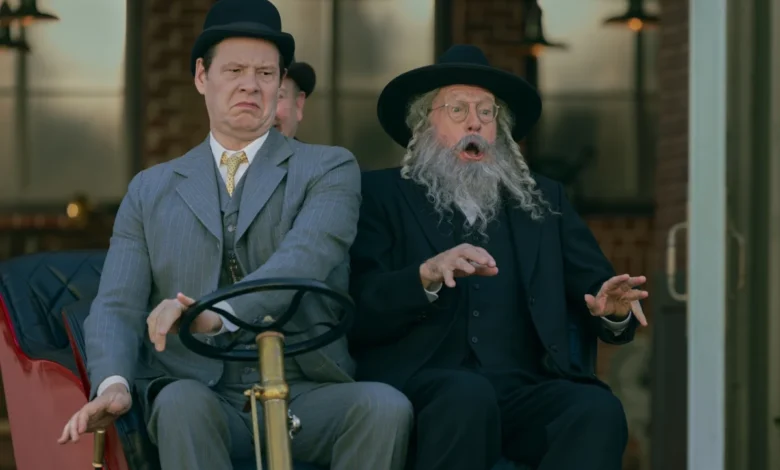
Following the conclusion of his era-defining sitcom Curb Your Enthusiasm, Larry David has made a swift and high-profile return to television with Life, Larry and the Pursuit of Unhappiness. Streaming on Max and airing Friday nights on HBO, the series represents a significant stylistic departure for the legendary comedian, trading the contemporary social faux pas of modern-day Los Angeles for a satirical lens focused on the foundational and pivotal moments of American history. Produced in collaboration with Higher Ground Productions, the media company founded by former President Barack Obama and Michelle Obama, the series has quickly become a focal point of the cultural zeitgeist, blending David’s signature curmudgeonly observations with a star-studded ensemble cast and high-level production values.
The series is structured as a historical sketch comedy, with each episode tackling various eras of the American experience—from the Revolutionary War to the Cold War and beyond. While David remains the central figure, often portraying historical figures or fictionalized observers caught in the machinery of history, the show is notable for its immense roster of guest stars. Unlike the improvisational, low-stakes cameos common in Curb Your Enthusiasm, Life, Larry and the Pursuit of Unhappiness features dozens of Academy Award, Emmy, and Tony winners in fully realized, period-accurate roles.
Strategic Partnership with Higher Ground Productions
The involvement of Barack and Michelle Obama as executive producers has provided the series with a unique level of prestige and institutional weight. Higher Ground Productions, which has previously focused on documentaries such as the Academy Award-winning American Factory and scripted dramas like Rustin, marks its first major foray into prestige sketch comedy with this project.
Industry analysts suggest that the partnership serves a dual purpose: it allows the Obamas to engage with American history through a more accessible, albeit satirical, medium, while providing Larry David with the resources to execute a large-scale period piece. The former President even appears in the series premiere, lending an air of officiality to the proceedings before participating in the self-deprecating humor that has become a hallmark of his post-presidency media appearances.
A Detailed Chronology of the First Five Episodes
The first half of the season has established a clear formula: a mix of "great man" history dissected through David’s neurotic lens and the elevation of minor historical grievances to the level of national crisis.
Episode 1: Livingston
The series debut, titled "Livingston," centers on the drafting of the Declaration of Independence. Larry David portrays Robert Livingston, a member of the Committee of Five who famously did not sign the final document. In David’s telling, Livingston is sidelined not by political disagreement, but by his insistence on including petty grievances about neighbors and local commerce in the founding document. The sketch features Henry Winkler as John Hancock and Chris Parnell as Benjamin Franklin, creating a comedic friction between the idealized "Founding Fathers" and David’s modern cynicism.
The episode also features a segment on the invention of the telephone, with David playing Alexander Graham Bell. In a nod to modern tech entitlement, the crowd—including Richard Kind as Thomas Watson—immediately begins complaining about the lack of features like text messaging and aesthetic color options. The premiere concludes with a segment featuring Jurnee Smollett as Rosa Parks, where David plays an oblivious bus passenger who attempts to engage the civil rights icon in a debate about seat-saving etiquette.
Episode 2: Farewell
The second installment serves as a historic reunion for the creators of Seinfeld. Jerry Seinfeld joins David to portray Lewis and Clark. The sketch reframes the legendary expedition as a "boys’ trip" gone wrong, with the duo more concerned with the quality of their rations and the lack of comfortable lodging than the mapping of the Louisiana Territory. Rita Wilson appears as Mavis Lewis, providing a grounded foil to the pair’s bickering.
A poignant highlight of the episode is the final screen performance of the late Rob Reiner. Reiner portrays George Washington in a segment discussing the transition of power and the establishment of term limits. The sketch uses the setting of the 18th century to offer meta-commentary on contemporary political figures, supported by appearances from Jimmy Kimmel and Larry Wilmore.
Episode 3: McCarthy
In the third episode, the series tackles the Red Scare of the 1950s. Larry David takes on the role of Senator Joseph McCarthy, transforming the infamous inquisitor into a man whose paranoia is driven as much by social slights as by political ideology. Michael McKean delivers a recreation of the famous "Have you no decency?" speech, though in this version, the argument devolves into a dispute over courtroom seating arrangements.
Earlier in the episode, Lin-Manuel Miranda appears in a segment regarding the Boston Tea Party. Leveraging his association with American historical drama, Miranda plays a revolutionary leader who must contend with David’s character, who is more concerned with the waste of high-quality tea than the protest against "taxation without representation."
Episode 4: Deepthroat
Watergate receives the David treatment in the fourth episode, where he portrays "Deep Throat," the anonymous informant. Rather than providing Woodward and Bernstein (played by Beck Bennett) with the keys to the Nixon administration’s downfall, David’s informant uses the secret meetings to complain about his dry cleaning and the logistics of parking in the District of Columbia.
The episode gained significant social media traction for a sketch involving the polio vaccine. David portrays the mother of Jonas Salk, engaging in a "my son the doctor" routine with a neighbor played by Judy Gold. The segment includes a sharp parody of modern vaccine skepticism, featuring a character named Bobby (played by Gregg Perrie) who echoes contemporary anti-vaccination rhetoric. This was widely interpreted by viewers as a satirical jab at Robert F. Kennedy Jr., the husband of David’s former co-star Cheryl Hines.
Episode 5: Lincoln
The fifth episode focuses on two iconic moments of the 19th century: the Gunfight at the O.K. Corral and the assassination of Abraham Lincoln. In the former, Timothy Olyphant and Don Johnson reprise their Western archetypes to argue with David about the "proper" way to initiate a shootout.
The finale of the episode features Bill Hader as Abraham Lincoln and Kathryn Hahn as Mary Todd Lincoln. The sketch focuses on the night at Ford’s Theatre, but rather than focusing on the impending tragedy, it centers on a domestic dispute over a stolen sweater and the difficulty of watching a play when seated behind someone with a tall hat. The segment highlights the show’s ability to humanize—and trivialize—figures of immense historical gravity.
Production Data and Industry Impact
The production of Life, Larry and the Pursuit of Unhappiness is notably more complex than David’s previous work. According to industry reports, the series utilizes high-end costume design and period-accurate sets, a stark contrast to the handheld, "run-and-gun" style of Curb Your Enthusiasm. This shift suggests a significant investment from Warner Bros. Discovery as they seek to bolster the Max original programming slate following the platform’s recent rebranding.
The show’s viewership data, while not fully released by Max, indicates a strong performance among the 25-54 demographic, particularly those who followed David’s work on HBO over the last two decades. The series also benefits from its "appointment viewing" Friday night slot, a traditional home for HBO’s prestige comedy and talk programming.
Broader Implications and Analysis
The transition from contemporary observational humor to historical satire allows Larry David to address universal human flaws that transcend time. By placing modern neuroses into the mouths of historical giants, the show suggests that human nature—specifically our tendency toward selfishness, pettiness, and social awkwardness—is the one true constant in the American story.
Furthermore, the show’s reliance on a revolving door of A-list talent serves as a testament to David’s standing in the industry. The ability to cast performers like Samuel L. Jackson, Jon Hamm, and Kaley Cuoco in minor sketch roles indicates a high level of "talent-buy-in," where actors are willing to participate in the project for the prestige of working with David and the Obamas.
As the series continues its first season, it remains a unique experiment in the landscape of streaming television. It manages to satisfy the cravings of Curb Your Enthusiasm fans for David’s specific brand of humor while offering a more structured, educational (albeit distorted), and visually ambitious product. By examining the "Pursuit of Unhappiness" throughout the centuries, Larry David has found a way to make the past feel as frustratingly relatable as the present.